
What Probate Covers in Ellis County
Probate settles the estate of a person who has died. The court confirms whether a valid will exists, names someone to manage the estate, sees that debts and taxes are paid, and orders what is left to pass to the right heirs. Oklahoma sets these rules under Title 58, the state's probate procedure code. You can read the full statute in the official Title 58 Probate Procedure PDF hosted by the Oklahoma Senate. The same court branch also handles living matters such as guardianships and conservatorships, where a judge protects a child or an adult who cannot manage alone.
Ellis County has no stand-alone probate court. Probate is heard in the Probate Division of the Ellis County District Court, and the case files are maintained by the Ellis County Court Clerk at the courthouse in Arnett. The clerk keeps the wills, the letters, the inventories, and the final decrees. A single estate can run for months, so the file grows as the case moves. Most estate files stay open to the public unless a judge seals part of the record.
Probate work in the district court reaches several record types:
- Wills and the admission of wills to probate.
- Letters testamentary and letters of administration.
- Estates with assets that need court administration.
- Guardianships and conservatorships.
- Trust-related proceedings.
- Final accounts, decrees of distribution, creditor notices, inventories, and orders.
Probate Terms Defined
Probate paperwork leans on a handful of legal words. The short list below explains the terms you are most likely to meet when you open an Ellis County estate file or read a docket entry. Each one points to a real role or a real status in a case.
- Testator
- The person who made the will. The testator's wishes guide how the estate is shared once the court accepts the will as valid.
- Executor
- The person named in the will to carry it out. The court issues letters testamentary so the executor can act for the estate.
- Intestate
- Dying without a valid will. When this happens, state law decides who inherits, and the court appoints an administrator instead of an executor.
- Guardianship
- A court arrangement that gives one person legal authority over the care of a minor or an adult who cannot care for themselves.
- Conservatorship
- A court arrangement focused on managing the money and property of a person who cannot handle their own financial affairs.
How to Search Ellis County Probate Records
Two statewide systems carry Oklahoma district court dockets, and Ellis County probate cases run through both. The Oklahoma State Courts Network, known as OSCN, is the official network. On Demand Court Records, known as ODCR, is a participating-court vendor that works well as a backup and a payment path. Probate cases use the PB prefix, so a docket might read PB-2023-1 for the first probate filed that year. Neither system replaces the Court Clerk for certified copies.
Start online, then call the clerk for anything the screen will not give you:
- Open the OSCN docket search and pick Ellis County District Court from the county dropdown.
- Enter a case number with the PB prefix if you have one, or switch to a party-name search using the Last, First format.
- If OSCN returns nothing, run the same name through the ODCR search page, choose Oklahoma District Courts, and select Ellis in the court list, then set the case type to Probate Proceedings.
- Read the result for the case number, the parties, the filing date, and the docket activity.
- When a document shows as office-only or does not appear online, contact the Ellis County Court Clerk for the certified copy, the older file, or the will itself.
Note: guardianship dockets may be limited online because parts of those files are confidential under Oklahoma court rules.
Where Ellis County Probate Records Are Kept
The Probate Division sits inside the Ellis County District Court, and the Court Clerk is the records keeper for the whole district court. Sally Wayland holds that office. For certified probate copies, will filings, older estate files, and records that never reach the web, the clerk's counter in Arnett is the source of record. Call ahead before a long drive, because the office is small and rural travel takes time.
Ellis County Court Clerk (Probate Division of the District Court)
100 South Washington Street
Arnett, OK 73832
(580) 885-7255
Mon-Fri 8:30 a.m. to 4:30 p.m.
Some probate-related papers are recorded with the County Clerk rather than filed in the case docket. The County Clerk keeps land records and recorded instruments, and Lynn Smith runs that office at the same courthouse. Deeds that move estate property, decrees, and recorded wills often land here. The county's public land index is searchable online and reaches back many decades.
Ellis County County Clerk (Recorded Instruments)
100 South Washington Street
Arnett, OK 73832
(580) 885-7301
Mon-Fri 8:30 a.m. to 4:30 p.m.
Ellis County in the Oklahoma Judicial Map
Estate matters stay in state district court, but Ellis County also sits inside a federal judicial district, which sometimes matters when an estate touches a federal claim. The U.S. Department of Justice lists every county in the district on its Western District of Oklahoma county page, and Ellis County appears on that roster.
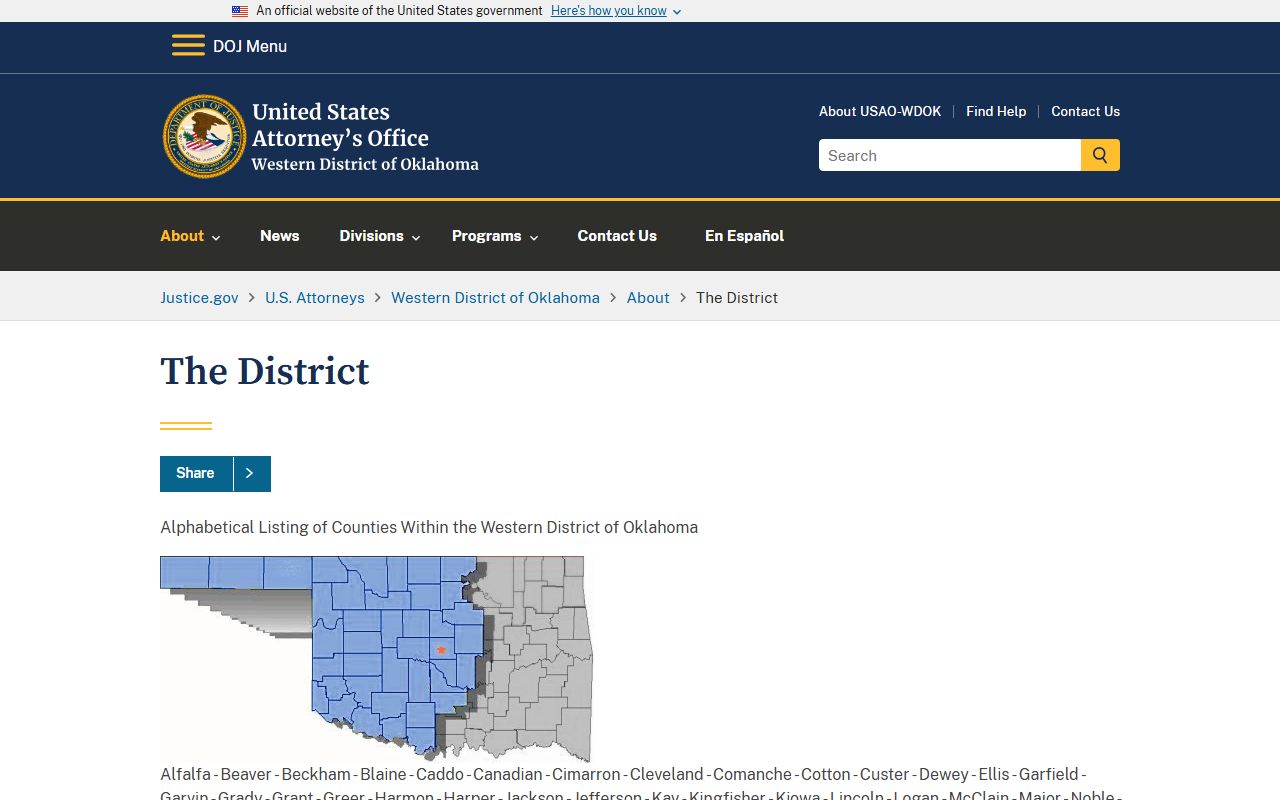
That federal list is a jurisdiction reference, not a probate portal, so do not look there for a will or an estate file. It only confirms which federal district covers the county for the rare matters that leave state court.
The boundaries of Oklahoma's federal districts are set in statute. The Cornell Law School Legal Information Institute publishes the text of 28 U.S.C. 116, which spells out the counties grouped into each Oklahoma judicial district.
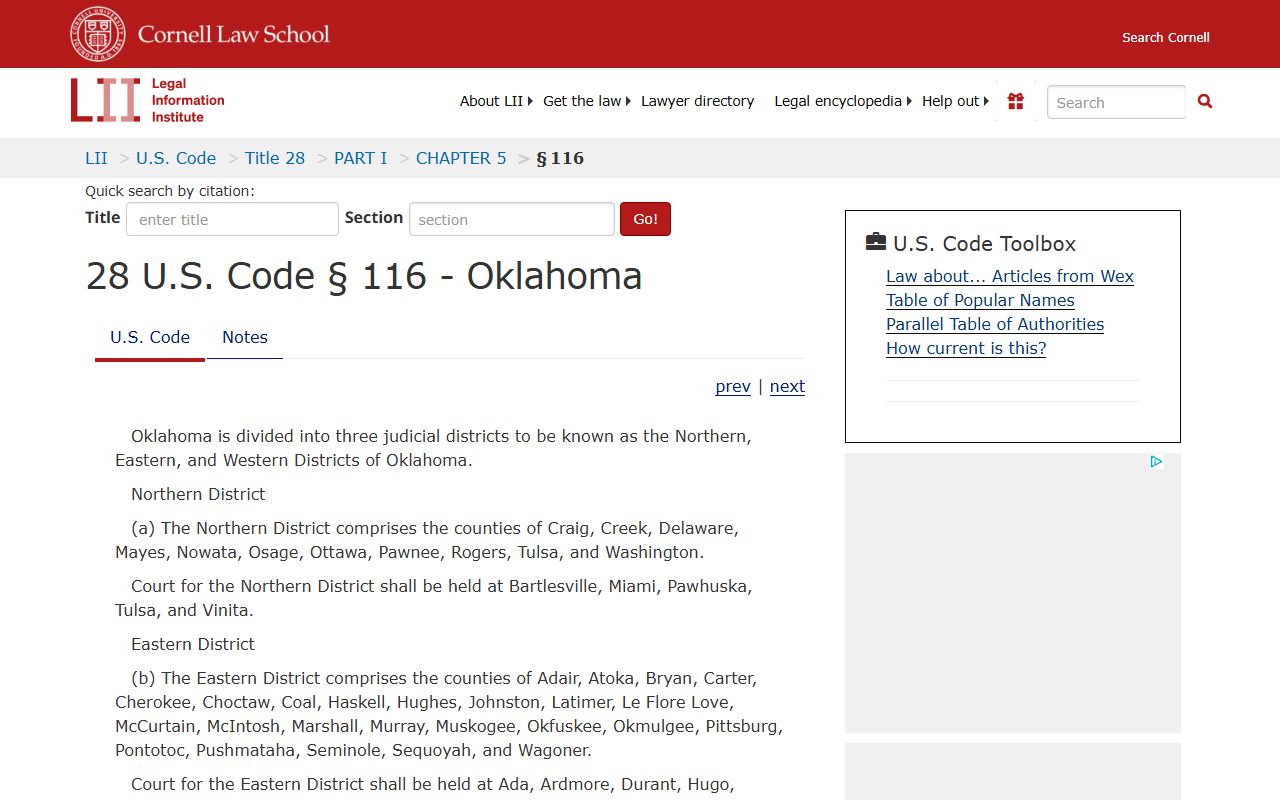
This statute is legal background only. For an actual Ellis County probate records search, the OSCN and ODCR dockets and the Court Clerk remain the working tools.
Probate Filing Fees
A clear Ellis County probate fee schedule was not located in an official county source, so the safe step is to call the Court Clerk at (580) 885-7255 for the current amounts and accepted payment methods. The table below is a statewide comparison only. The dollar figures come from Oklahoma County guidance for a different county, and they are shown to give a sense of scale, not to state Ellis County prices.
| Item | Amount |
|---|---|
| Probate estate filing (Oklahoma County comparison) | $204.14 plus publication if applicable |
| Guardianship filing (Oklahoma County comparison) | $204.14 |
| Conservatorship filing (Oklahoma County comparison) | $154.14 |
| Relative guardianship (Oklahoma County comparison) | $67.00 |
| Ellis County probate filing | Not located; call the Court Clerk |
Publication fees can apply on top of the filing fee because Oklahoma probate often requires notice in a local newspaper. Certified copy charges and search fees are set by the clerk as well. Confirm every figure with the Ellis County Court Clerk before you file, since small rural offices may differ from large metro courts.
The Ellis County Probate Process
Most estates follow a familiar path through the district court. The exact steps depend on the size of the estate and whether a will exists. A small estate may qualify for an affidavit or a simplified path under state law, which skips a full probate. Larger estates with real property, mineral interests, or contested heirs usually need the full court process.
- Decide whether a full probate is needed or whether a small-estate affidavit under Oklahoma law will work.
- File the petition in the Ellis County District Court when Ellis County is the proper venue for the estate.
- Give the required notices, including newspaper publication when the law calls for it.
- The court appoints a personal representative or admits the will once the statutory requirements are met.
- The representative collects the assets, gives creditor notice, files an inventory and accounting, and resolves debts and taxes.
- The representative asks the court to approve distribution and close the estate.
- Certified orders and letters come from the Court Clerk, and any property-transfer deeds get recorded with the County Clerk.
Mineral and oil-and-gas interests are common in this part of northwest Oklahoma, so an estate here may involve a personal representative deed or a deed of distribution that has to be recorded against specific land. That is why the County Clerk's recorded-instrument index matters alongside the court docket.
What Ellis County Probate Records Show
An open estate file builds a paper trail from the first petition to the final decree. The contents tell the story of who died, who is in charge, what the estate holds, and who gets what. Genealogists, heirs, title researchers, and creditors all read these files for different reasons.
A typical Ellis County probate file can include:
- The petition for probate and the will, if one was left.
- Orders admitting the will and appointing a representative.
- Letters testamentary or letters of administration.
- The inventory and appraisal of estate assets.
- Creditor notices and claims against the estate.
- Accountings, the final account, and the decree of distribution.
Some documents show online as docket entries while the full image stays at the courthouse. For a certified copy that a bank, a title company, or another court will accept, the screen version is not enough. The certified copy has to come from the Court Clerk. Marriage and divorce filings tied to the same family follow a separate track through the Ellis County marriage and divorce records held by the same clerk.
Recorded Probate Instruments at the County Clerk
When probate moves real property, the transfer is recorded in the land records, not just noted in the court file. The Ellis County County Clerk runs a public land-record portal through OKCountyRecords. Indexed data there reaches back to January 1901, scanned images start in January 1938, and new records are added in real time. That depth makes it a strong tool for estate research that touches local land.
The instrument-type dropdown on the portal includes several probate-useful categories. Searchers tracking an estate through the land records can filter for these recorded papers:
- Will and Petition For Probate.
- Final Decree and Decree Determining Heirs.
- Letters Of Administration and Letters Testamentary.
- Personal Representative Deed.
- Deed Of Distribution.
A name search in the County Clerk portal can confirm that an estate's property transfer was actually recorded, which is the step that clears title for the heirs. The court file shows the order, and the recorded deed shows the result.
Restricted Probate Records
Most estate files are public, but probate also covers matters that the law protects. Guardianship records may be confidential, and review can be limited to the attorneys of record, the guardian, the ward, or anyone the court allows by order. Adoption records are confidential as well and need statutory authority or a court order to open. Mental health proceedings are often closed and do not search like ordinary civil files.
Even in an open estate file, certain details get shielded. Social Security numbers, financial account numbers, the names of minors, and protected addresses may be redacted before the public sees a document. If a record you expect to find does not appear in the docket, a confidentiality rule or a sealing order may be the reason. The Ellis County Court Clerk can confirm whether a file is restricted and what access path, if any, is open to you. For a wider view of how Oklahoma treats open and sealed files, the general framework appears across the county's court records resources.