
Ellis County Arrest Records and Court Charges
An Ellis County arrest record is the account of an arrest itself. It shows who was taken into custody, the agency that made the arrest, and the booking that follows at the county jail. In Ellis County, most arrests are made by the Ellis County Sheriff's Office under Sheriff Shane Booth, with some made by state troopers or city officers. Booking does not file charges. The decision to charge belongs to the prosecutor. Once an arrest occurs, the District Attorney for District 2, Angela Marsee, reviews the reports and decides which formal charges to file with the Court Clerk. Those filed charges become the charge record that the case carries from start to finish.
The two records sit on different sides of the system. The arrest record lives on the booking and sheriff side, where the jail roster lists current custody and basic booking detail. For that roster and the custody data behind it, the Ellis County inmate records page is the right starting point. The court charge record is separate. It reflects court charges after arrest, meaning the exact counts the prosecutor filed, tracked through each hearing. The full case file, with pleas, disposition, and sentence, is covered on the criminal court records page. Reading both gives the clearest picture.
The Oklahoma Sheriffs' Association lists Sheriff Shane Booth and the Ellis County office on its Ellis County sheriff page, a useful confirmation of who handles arrests locally.
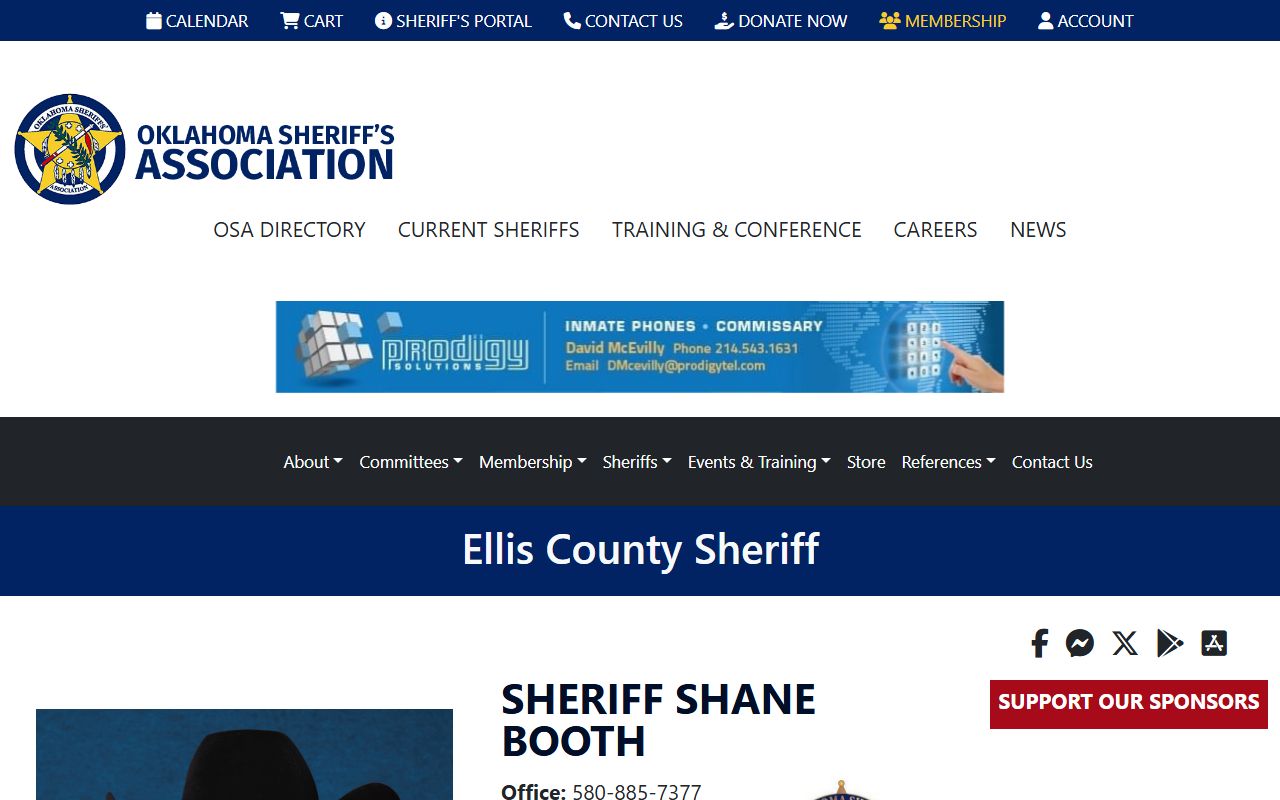
That listing matters because the arresting agency is one of the first fields an arrest record carries, and it sets up which office to call for booking questions the court file will not answer.
How to Find Ellis County Arrest Records and Charges
Charges and their status show up in the District Court case file, not on the jail roster. The main path is the statewide court search. The Oklahoma State Courts Network, known as OSCN, hosts docket search for Ellis County District Court. On Demand Court Records, or ODCR, is a second search and payment channel that lists Ellis in its court menu. Both let you open a case and read each charge. Arrest and booking detail, by contrast, stays with the sheriff's roster, so a complete look usually means checking both sources.
- Open the OSCN docket search at oscn.net and choose Ellis County District Court from the county dropdown, or use the ODCR search at odcr.com and select Ellis.
- Search by the defendant's name in Last, First format, or enter a known case number using the Oklahoma prefix, such as CF for felony or CM for misdemeanor.
- Open the matching case and read the charge list, including the charge text, the statute cited, and the offense date.
- Check each charge's code, severity level, and current status so you can tell a pending count from one that was amended, reduced, or dismissed.
When a record is not online, the access does not stop there. The Ellis County Court Clerk, Sally Wayland, can provide certified case copies by phone at (580) 885-7255 or by mail at P.O. Box 217, Arnett, OK 73832. Booking information that is not posted on the roster can be requested from the Sheriff's Office at (580) 885-7377 under the Oklahoma Open Records Act. Questions about why a particular charge was filed or amended go to the District Attorney at (580) 885-7505.
How Charges Get Filed After an Arrest
The arrest comes first, at booking. The charge record begins later, when the prosecutor files a charging document with the court. That document is what turns an allegation into a formal case. In Oklahoma, three kinds of charging documents do this work, and the type depends on the offense level and how the case reaches the court. A complaint and an information are the common routes in District Court, while an indictment comes from a grand jury for the most serious matters.
| Complaint | Information | Indictment | |
|---|---|---|---|
| Filed By | Officer or prosecutor | District Attorney | Grand Jury |
| Common For | Misdemeanors | Many felonies | Serious felonies |
| Basis | Sworn allegation | Probable cause review | Grand jury vote |
| Starts | The case | The case | The case |
Each document lists one or more counts. A count is a single charge, so one arrest can lead to several counts in the same filing. The District Attorney for District 2 prosecutes these state charges for Ellis County and can amend, add, or drop counts as the case develops. Note: a charge is a filed allegation, not a conviction, and it should never be read as proof of guilt.
Charge Status and What It Means
Charges rarely stay frozen. As a case moves, counts can be amended, reduced, added, dropped, or dismissed, and the docket records each change. Reading the status next to each charge tells you where the count stands right now. The same case can hold one pending count, one reduced count, and one dismissed count at the same time, so it pays to read every line rather than the first entry alone.
| Status | What It Means |
|---|---|
| Pending | The charge has been filed and the case is still open, with no final outcome entered yet. |
| Amended / Reduced | The prosecutor changed the charge, often to a lower offense level such as a felony lowered to a misdemeanor. |
| Dismissed | The court ended the charge; a dismissal without prejudice can be refiled, while one with prejudice cannot. |
| Nolle Prosequi | The prosecutor chose not to pursue the charge, formally declining to proceed on that count. |
Status also drives what a later search shows. A charge that was dropped or dismissed can read very differently from the booking entry that started the case, which is one reason the arrest record and the court charge record are checked together.
Charges vs. Convictions
Being charged is not the same as being convicted. A charge is the accusation a prosecutor files. A conviction is a finding or plea of guilt entered as judgment by the court. Many filed charges never become convictions, because counts get reduced, dismissed, or declined. Treating a charge as a guilty result is a common and costly mistake.
| Charge | Conviction | |
|---|---|---|
| Stage | Accusation | Verdict or plea |
| Burden of Proof | Probable cause | Beyond a reasonable doubt |
| Who Decides | Prosecutor | Judge or jury |
| Public Record | Yes | Yes |
The standard of proof is the key gap. A charge needs only probable cause, a reasonable basis to believe an offense happened. A conviction requires proof beyond a reasonable doubt. The arrest opens the door, the charge frames the accusation, and only the disposition tells you the result.
Sealed vs. Expunged Records
Some arrest and charge records are removed from public view. Oklahoma law allows eligible records to be sealed or expunged under Title 22, Sections 18 and 19. The two are not identical. A sealed record is withheld from ordinary public access, while an expunged record is treated as though it never existed for most purposes. The Oklahoma State Bureau of Investigation handles the statewide criminal-history side of this process.
| Sealed | Expunged | |
|---|---|---|
| Visibility | Hidden from public | Treated as never existed |
| Law Enforcement | Limited access | Very limited access |
| Eligibility | Set by 22 O.S. statute | Set by 22 O.S. Section 18 categories |
The person seeking relief files in the District Court that handled the arrest or case. The OSBI states plainly that it cannot pre-approve eligibility, since eligibility comes from statute, and its criminal-history expungement page directs filers to Title 22. If a court grants the order, custodians such as the Court Clerk seal or update the covered records.
Charge Codes and Severity Levels
Every charge ties back to a statute. The charge text on a docket usually appears with the Oklahoma statute it cites, and the case prefix signals the severity level. A CF prefix marks a criminal felony, CM marks a criminal misdemeanor, and probable-cause filings appear under their own category. Felonies carry the most serious penalties, misdemeanors are lower-level offenses, and a single arrest can produce several separate counts spread across those levels.
Reading the code matters because the level shapes everything that follows, from bond to the court track. A felony count and a misdemeanor count behave differently even when they come from the same incident. The District Attorney can also amend a charge to a different statute, which changes both the code and the severity, so the charge a person was booked on is not always the charge that ends up filed.
Statewide Charge and Criminal History Lookups
A single county case file is not the same as a statewide criminal history. In Oklahoma, the statewide criminal-history product comes from the Oklahoma State Bureau of Investigation, and it is a separate record from the Ellis County District Court charge record. The court file shows the charges filed in one case. The OSBI history pulls together records from across the state into one report, which is what most formal background screens rely on.
Defendants who cannot afford counsel are served by the statewide indigent defense system. The Oklahoma Indigent Defense System, or OIDS, provides representation when a District Court finds a defendant indigent. Its overview appears on the official Oklahoma Indigent Defense System page.
That system matters to the charge record because appointed counsel can challenge or negotiate the filed charges, which is often how counts get amended or reduced on the docket.
Background Check Considerations
There is a real gap between a casual record lookup and a regulated background check. Searching OSCN or ODCR for a name gives a quick read on filed charges, but it is not a compliant employment or tenant screen. Formal screening must follow the federal Fair Credit Reporting Act and pull from authorized sources, and a casual court search does not meet that standard. For Ellis County, the official channels are the court portals, the Court Clerk for certified copies, and the OSBI for statewide criminal history.
Important: This site is not a consumer reporting agency under the FCRA, and its information cannot be used for employment, tenant, credit, or other FCRA-regulated screening decisions.
Restricted Charge Records in Ellis County
Not every arrest or charge record is open. Oklahoma's Open Records Act, found at 51 O.S. Section 24A.1 and following, supports public access to most law-enforcement and court records, and Section 24A.8 covers arrest and booking facts. Several categories stay restricted, though. Juvenile charges are generally confidential and do not appear like adult dockets. Sealed and expunged charges drop out of public view once a valid order is entered. Active investigations and some search-warrant materials can be withheld while a case is open.
When a record is restricted, the route is to confirm status with the office that holds it. The Ellis County Court Clerk can explain what a case file shows and what is sealed. The District Attorney's office can address charging questions, and the Sheriff's Office handles booking information through an Open Records request. The Oklahoma Open Records Act text is published on the state's Open Records Act page for readers who want the governing statute.
The Oklahoma Association of Chiefs of Police directory also lists the Ellis County Sheriff's Office with its Arnett address and phone.
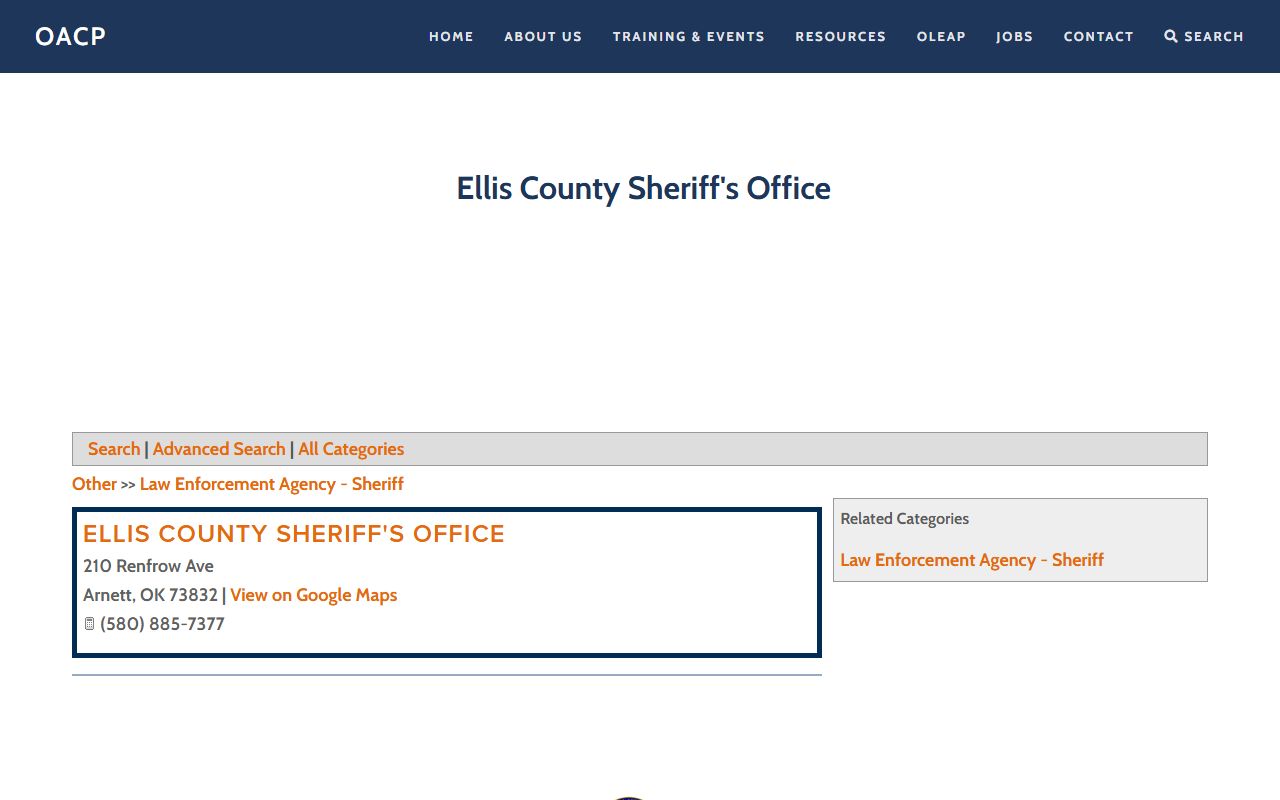
That directory entry is the contact point for booking and arrest information the court charge record does not include, which closes the loop between the arrest side and the charges filed afterward.